
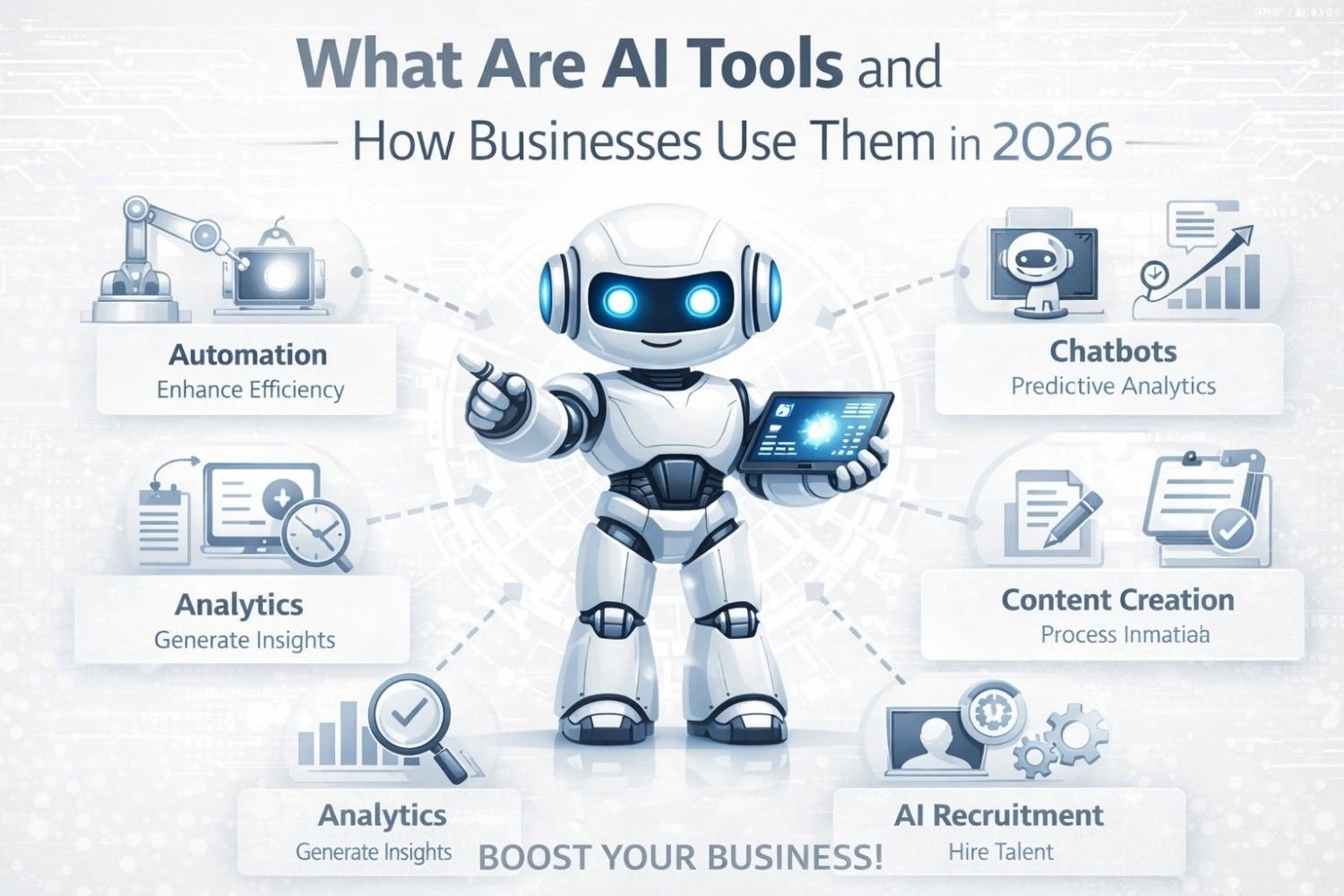
AI tools for business have moved from experimental technology to a core engine of growth, efficiency, and competitive advantage. Across Tier-1 markets such as the United States, United Kingdom, Canada, Australia, and Western Europe, organizations are rapidly adopting artificial intelligence software to automate operations, cut costs, and make smarter data-driven decisions.
This SEO-optimized guide explains what AI tools are, how they work, and how modern companies use them to achieve measurable ROI and scalable growth.
What Are AI Tools?
AI tools are software applications powered by artificial intelligence technologies such as machine learning (ML), natural language processing (NLP), computer vision, and predictive analytics. These tools perform tasks that traditionally required human intelligence.
Unlike conventional software, AI-powered business tools can:
- Learn continuously from data
- Adapt to changing inputs
- Automate complex decisions
- Improve accuracy over time
This self-improving capability makes AI tools extremely valuable for modern enterprises.
Core Technologies Behind AI Tools
Machine Learning (ML)
Machine learning enables systems to detect patterns in data and generate predictions without explicit programming. It powers forecasting, recommendation engines, and fraud detection.
Natural Language Processing (NLP)
NLP technology allows AI to understand and generate human language, enabling chatbots, virtual assistants, sentiment analysis, and AI content tools.
Computer Vision
This technology allows machines to interpret images and video, supporting use cases such as quality inspection, facial recognition, and medical imaging.
Predictive Analytics
Predictive AI models forecast future outcomes using historical data, helping businesses make proactive strategic decisions.
Why Businesses Are Rapidly Adopting AI Tools
Organizations in high-value markets invest in AI business automation for several strategic reasons:
- Greater operational efficiency
- Significant cost reduction
- Enhanced customer experience
- Real-time data intelligence
- Scalable growth capabilities
AI adoption is now a key competitive differentiator in global markets.
Common Types of AI Tools for Business
AI Automation Tools
These tools automate repetitive workflows such as data entry, scheduling, invoice processing, and reporting.
AI Analytics Platforms
Advanced analytics tools process massive datasets to uncover patterns, trends, and predictive insights.
AI Customer Support Tools
AI chatbots and virtual assistants provide 24/7 customer service while reducing support costs.
AI Marketing Tools
Marketing AI optimizes ad targeting, personalization, email automation, and campaign performance.
AI Sales Tools
Sales intelligence platforms score leads, predict conversions, and recommend next-best actions.
How Businesses Use AI Tools
1. Intelligent Process Automation
AI workflow automation eliminates manual bottlenecks and reduces human error in routine operations.
2. Advanced Data Analysis and Forecasting
AI systems analyze large datasets in seconds, enabling faster and more accurate business forecasting.
3. Customer Experience Personalization
AI delivers tailored recommendations, instant responses, and predictive support—boosting satisfaction and retention.
4. Fraud Detection and Risk Management
Financial institutions use AI to detect anomalies and suspicious transactions in real time.
5. HR and Talent Intelligence
AI assists with resume screening, employee analytics, workforce planning, and attrition prediction.
Industry Use Cases of AI Tools
- Finance: Fraud detection, algorithmic trading, credit risk scoring
- Healthcare: Diagnostics, patient monitoring, operational automation
- E-commerce: Recommendation engines, dynamic pricing, personalization
- Manufacturing: Predictive maintenance and quality control
- Marketing: Ad optimization, content generation, customer segmentation
AI Tools vs Traditional Software
| Aspect | Traditional Software | AI Tools |
|---|---|---|
| Learning Ability | Static | Continuous learning |
| Decision Logic | Rule-based | Data-driven |
| Scalability | Limited | Highly scalable |
| Automation Level | Basic | Advanced \& adaptive |
Key Benefits of AI Tools for Business
- Higher workforce productivity
- Lower operational expenses
- Improved accuracy and compliance
- Faster strategic decision-making
- Stronger competitive positioning
Challenges of Implementing AI Tools
Despite strong advantages, businesses should plan for:
- Initial implementation investment
- Data privacy and governance requirements
- Skill gaps and training needs
- Integration with legacy systems
With proper strategy, the long-term ROI typically far outweighs these challenges.
Why AI Tools Deliver High ROI in Tier-1 Markets
Companies in Tier-1 economies prioritize technologies that improve efficiency at scale. AI business tools align perfectly with:
- Premium customer experience expectations
- High labor cost environments
- Data-driven decision cultures
- Strict compliance requirements
This is why AI adoption continues to accelerate globally.
The Future of AI Tools in Business
Next-generation AI innovation will include:
- Generative AI for content and code
- Autonomous business workflows
- Decision intelligence platforms
- Hyper-personalized customer journeys
Early adopters of AI will maintain a strong competitive advantage in the digital economy.
Final Thoughts
AI tools for business are fundamentally reshaping how organizations operate, compete, and grow. From automation and analytics to customer engagement and risk management, AI delivers measurable efficiency gains and high ROI.
For companies aiming to scale faster and stay competitive in 2026 and beyond, adopting AI-powered business software is no longer optional—it is a strategic necessity.