
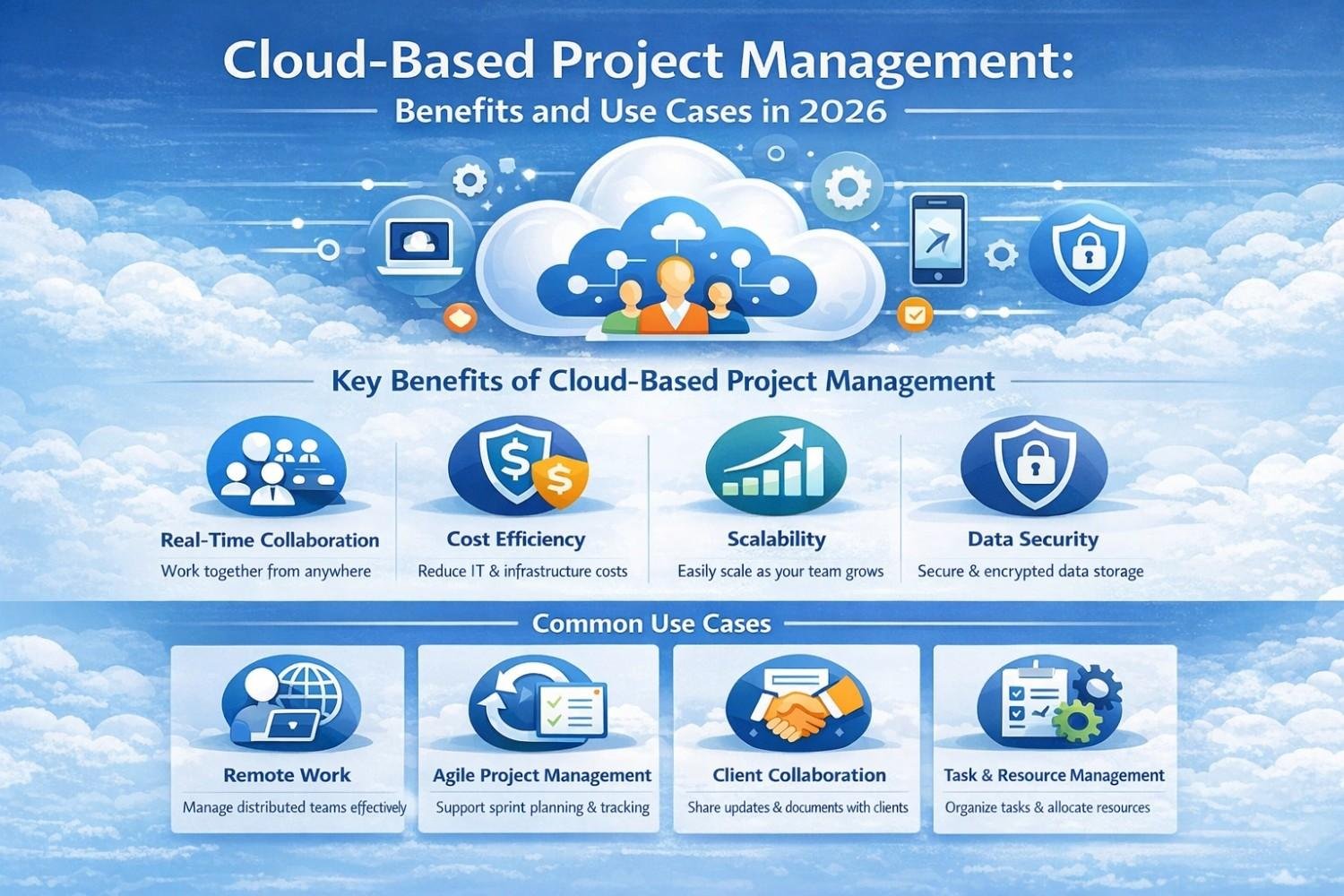
Cloud-based project management has become a cornerstone of modern business operations. As organizations accelerate digital transformation, companies across Tier-1 markets—including the United States, United Kingdom, Canada, Australia, and Western Europe—are rapidly adopting cloud project management software to improve collaboration, scalability, and operational efficiency.
This SEO-optimized guide explains the key benefits, real-world use cases, and ROI advantages of cloud-based project management platforms for businesses of all sizes.
What Is Cloud-Based Project Management?
Cloud-based project management software is an online platform hosted on remote cloud infrastructure that helps teams plan, execute, monitor, and deliver projects from any location. Unlike traditional on-premise systems, cloud solutions operate through web browsers or mobile apps.
Key characteristics:
- Web-based remote access
- Real-time team collaboration
- Automatic software updates
- Subscription-based pricing (SaaS model)
This model has fundamentally transformed how distributed and hybrid teams operate.
Why Businesses Are Moving to Cloud Project Management
The global shift toward cloud project management tools is driven by major business trends:
- Growth of remote and hybrid work
- Rising IT infrastructure costs
- Demand for scalable solutions
- Need for real-time project visibility
Cloud platforms align perfectly with modern enterprise requirements.
Core Benefits of Cloud-Based Project Management
1. Anytime, Anywhere Accessibility
Cloud project management software enables teams to access projects from any device with internet connectivity.
- Seamless remote collaboration
- Faster executive decision-making
- Improved workforce flexibility
For globally distributed teams, this accessibility is mission-critical.
2. Real-Time Collaboration and Updates
Unlike traditional offline tools, cloud PM platforms provide instant synchronization across all users.
- Live task updates
- Instant notifications
- Shared project dashboards
- Version control
This eliminates communication gaps and reduces project delays.
3. Lower IT and Infrastructure Costs
One of the biggest advantages of SaaS project management software is cost efficiency.
- No on-premise servers required
- Reduced IT maintenance costs
- Predictable subscription pricing
- Lower total cost of ownership (TCO)
This makes cloud solutions especially attractive for startups and growing enterprises.
4. Effortless Scalability
Cloud platforms scale instantly as business needs evolve.
- Add users in minutes
- Upgrade storage and features on demand
- Support global team expansion
This flexibility is a major advantage over traditional systems.
5. Enterprise-Grade Security and Compliance
Leading cloud project management providers invest heavily in cybersecurity infrastructure.
- End-to-end encryption
- Multi-factor authentication (MFA)
- Role-based access controls
- Compliance with GDPR, SOC 2, ISO 27001
In many cases, cloud security exceeds on-premise protection levels.
6. Automatic Updates and Continuous Innovation
Cloud software evolves without manual intervention.
- Automatic feature releases
- Instant security patches
- No upgrade downtime
Teams always operate on the latest version.
7. Deep Integration with Business Tools
Modern cloud project management systems integrate seamlessly with:
- CRM platforms
- Accounting and finance software
- Marketing automation tools
- Cloud storage services
- Communication platforms
This creates a unified digital workspace.
Cloud vs On-Premise Project Management
| Feature | Cloud-Based | On-Premise |
|---|---|---|
| Accessibility | Anywhere access | Office-bound |
| Scalability | High and elastic | Hardware-limited |
| Maintenance | Vendor-managed | In-house IT required |
| Upfront Cost | Low | High CAPEX |
Real-World Use Cases of Cloud-Based Project Management
1. Software Development and DevOps
Agile teams use cloud project management tools for sprint planning, bug tracking, CI/CD coordination, and release management—accelerating product delivery cycles.
2. Marketing and Creative Agencies
Agencies manage multiple campaigns, client approvals, and creative workflows in real time, improving turnaround speed and client satisfaction.
3. Enterprise Portfolio Management
Large organizations use executive dashboards for resource forecasting, budget control, and cross-project visibility.
4. Remote and Hybrid Workforces
Distributed teams benefit from standardized workflows, centralized documentation, and real-time accountability across time zones.
5. Construction and Engineering Projects
Field teams use mobile-enabled cloud platforms to manage schedules, vendors, compliance documents, and site reporting efficiently.
Business ROI of Cloud Project Management Software
Organizations adopting cloud PM solutions typically report:
- Reduced project delays
- Lower operational costs
- Higher team productivity
- Improved client satisfaction
- Better resource utilization
These measurable gains drive strong long-term ROI.
Future Trends in Cloud Project Management
The next generation of platforms will increasingly include:
- AI-powered project forecasting
- Predictive risk analytics
- Hyperautomation workflows
- Advanced performance dashboards
- Intelligent resource optimization
These innovations will further reduce project failure rates and improve delivery precision.
Final Thoughts
Cloud-based project management software is no longer optional—it is a strategic necessity for organizations competing in high-performance global markets. With superior flexibility, scalability, security, and cost efficiency, cloud platforms enable teams to work smarter and deliver faster.
Businesses that invest early in modern cloud project management tools position themselves for sustainable growth, operational excellence, and long-term competitive advantage.